
Liberty Medal

Liberty Medal
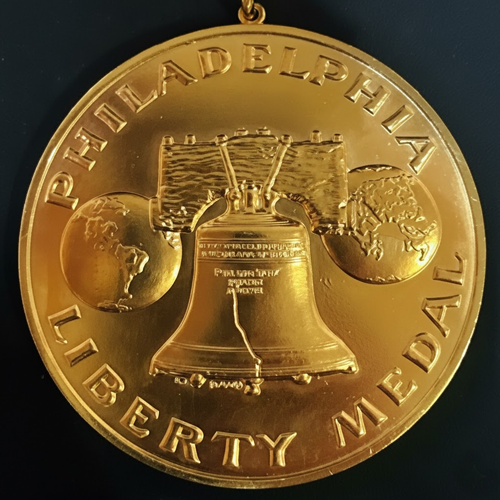
The Liberty Medal is an annual award presented by the National Constitution Center in Philadelphia. It honors individuals of "courage and conviction" who strive to secure the blessings of liberty for people worldwide. Originally founded by the Philadelphia Foundation, the medal is now the Center’s highest honor, often coinciding with Constitution Day celebrations.The medal’s prestige stems from its diverse and globally significant roster of recipients. It has been awarded to humanitarian icons like Nelson Mandela, Malala Yousafzai, and the 14th Dalai Lama, as well as political figures like Volodymyr Zelenskyy and Ruth Bader Ginsburg.In recent years, the award has expanded to recognize cultural and educational impact. In 2024, filmmaker Ken Burns was honored, while the 2025 Liberty Medal was awarded to the musical Hamilton and historian Ron Chernow for their roles in sparking a modern resurgence of interest in American constitutional history.
| Sl | Name | Country | Flag | Year | Awarded For |
|---|---|---|---|---|---|
| 47 | Hamilton (The Musical) | USA | 2025 | Bringing the U.S. Constitution to life for new generations. | |
| 46 | Ron Chernow | USA | 2025 | His biographical work inspiring the musical Hamilton. | |
| 45 | Ken Burns | USA | 2024 | Excellence in documentary filmmaking on American history. | |
| 44 | Judy Woodruff | USA | 2023 | Promoting civil dialogue and journalistic integrity. | |
| 43 | David Rubenstein | USA | 2023 | Patriotic philanthropy and preserving American history. | |
| 42 | Volodymyr Zelenskyy | Ukraine | 2022 | Heroic defense of liberty against Russian aggression. | |
| 41 | Loujain al-Hathloul | Saudi Arabia | 2021 | Advocacy for women's rights in Saudi Arabia. | |
| 40 | Jimmy Lai | China | 2021 | Courage in exercising freedom of speech and the press. | |
| 39 | Ruth Bader Ginsburg | USA | 2020 | Advancing liberty and gender equality. | |
| 38 | Anthony M. Kennedy | USA | 2019 | Preserving liberty through Constitutional education. | |
| 37 | George W. Bush | USA | 2018 | Commitment to veterans and national service. | |
| 36 | Laura Bush | USA | 2018 | Advocacy for global literacy and women's rights. | |
| 35 | John McCain | Panama | 2017 | A lifetime of sacrifice and service to the country. | |
| 34 | John Lewis | USA | 2016 | Courageous leadership in the Civil Rights Movement. | |
| 33 | 14th Dalai Lama | Tibet | 2015 | Advocacy for human rights and world peace. | |
| 32 | Malala Yousafzai | Pakistan | 2014 | Courage in advocating for girls' education. | |
| 31 | Hillary Rodham Clinton | USA | 2013 | Advocacy for women and girls' rights worldwide. | |
| 30 | Muhammad Ali | USA | 2012 | Humanitarianism and religious freedom advocacy. | |
| 29 | Robert Gates | USA | 2011 | Steady leadership and decades of public service. | |
| 28 | Tony Blair | UK | 2010 | Peace efforts in Northern Ireland. | |
| 27 | Steven Spielberg | USA | 2009 | Artistic contribution to history and human rights. | |
| 26 | Mikhail Gorbachev | Russia | 2008 | Ending the Cold War and expanding liberty. | |
| 25 | Bono | Ireland | 2007 | Global advocacy for debt relief and AIDS awareness. | |
| 24 | DATA (Organization) | UK | 2007 | Fighting poverty and disease in Africa. | |
| 23 | George H.W. Bush | USA | 2006 | Bipartisan humanitarian leadership. | |
| 22 | Bill Clinton | USA | 2006 | Leadership in global disaster relief efforts. | |
| 21 | Viktor Yushchenko | Ukraine | 2005 | Advancing democracy during the Orange Revolution. | |
| 20 | Hamid Karzai | Afghanistan | 2004 | Rebuilding democratic institutions in Afghanistan. | |
| 19 | Sandra Day O’Connor | USA | 2003 | Her historic service on the Supreme Court. | |
| 18 | Colin Powell | USA | 2002 | Leadership in military and diplomatic service. | |
| 17 | Kofi Annan | Ghana | 2001 | Promoting international peace and human rights. | |
| 16 | Dr. James D. Watson | USA | 2000 | Co-discovery of DNA's double helix structure. | |
| 15 | Dr. Francis Crick | UK | 2000 | Revolutionary contributions to genetic science. | |
| 14 | Kim Dae-jung | South Korea | 1999 | Advancing democracy and peace in the Korean peninsula. | |
| 13 | George Mitchell | USA | 1998 | Brokering the Good Friday peace agreement. | |
| 12 | CNN International | USA | 1997 | Commitment to the global free flow of news. | |
| 11 | King Hussein | Jordan | 1996 | Courageous leadership in Middle East peace. | |
| 10 | Shimon Peres | Belarus | 1996 | Efforts toward establishing regional stability. | |
| 9 | Sadako Ogata | Japan | 1995 | Leadership in international refugee protection. | |
| 8 | Vaclav Havel | Czech Republic | 1994 | Peaceful resistance against totalitarianism. | |
| 7 | Nelson Mandela | South Africa | 1993 | Dismantling apartheid through reconciliation. | |
| 6 | F. W. de Klerk | South Africa | 1993 | Ending apartheid and seeking a new constitution. | |
| 5 | Thurgood Marshall | USA | 1992 | Championing civil rights through the law. | |
| 4 | Médecins Sans Frontières | France | 1991 | Providing medical relief in global conflict zones. | |
| 3 | Oscar Arias Sanchez | Costa Rica | 1991 | Peace initiatives in Central America. | |
| 2 | Jimmy Carter | USA | 1990 | Post-presidential dedication to human rights. | |
| 1 | Lech Walesa | Poland | 1989 | Leading the Solidarity movement for freedom. |
Liberty Medal Laureates (2010 ~ 2001)
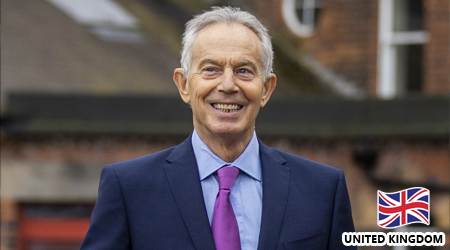
Tony Blair
Liberty Medal 2010
Sir Tony Blair served as the Prime Minister of the United Kingdom from 1997 to 2007, making him the longest-serving Labour Prime Minister in history. Rising to power at age 43, he was the youngest person to hold the office since 1812.Blair is best known for rebranding his party as "New Labour," shifting away from traditional socialism toward a centrist "Third Way" philosophy. His domestic legacy is marked by significant social and constitutional reforms, including the introduction of the national minimum wage, the Human Rights Act, and the historic Good Friday Agreement, which brought peace to Northern Ireland.However, his premiership remains deeply polarizing, primarily due to his decision to join the United States in the 2003 invasion of Iraq. While he won three consecutive general elections, the controversy over "weapons of mass destruction" and the subsequent instability in the Middle East significantly impacted his public approval and remains a central point of debate in his political legacy.

Steven Spielberg
Liberty Medal 2009
Steven Spielberg is widely considered the most commercially successful and influential director in cinematic history. Emerging as a pioneer of the "New Hollywood" era, he single-handedly invented the modern summer blockbuster with the 1975 release of Jaws. Over a career spanning six decades, he has mastered a vast array of genres, from high-concept science fiction like E.T. the Extra-Terrestrial and Jurassic Park to the swashbuckling adventure of the Indiana Jones series.Beyond spectacle, Spielberg is acclaimed for his profound historical and humanistic dramas. He earned Academy Awards for Best Director for Schindler’s List, a seminal depiction of the Holocaust, and Saving Private Ryan, noted for its visceral portrayal of World War II. As a co-founder of DreamWorks Pictures and Amblin Entertainment, his influence extends into producing and philanthropy, including his work with the USC Shoah Foundation to preserve survivor testimonies. Spielberg’s unique ability to blend technical innovation with deep emotional resonance has forever shaped the fabric of global entertainment.
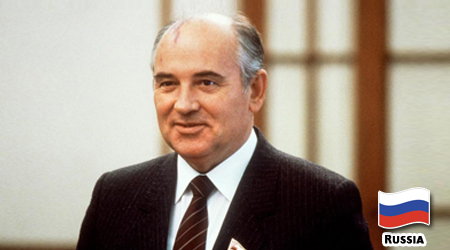
Mikhail Gorbachev
Liberty Medal 2008
Mikhail Gorbachev (1931–2022) was the final leader of the Soviet Union, serving from 1985 until its dissolution in 1991. He is globally recognized for his attempts to modernize the Soviet system through two signature policies: Glasnost ("openness") and Perestroika ("restructuring"). These reforms aimed to increase political transparency and introduce limited free-market elements into a stagnant economy.Gorbachev played a pivotal role in ending the Cold War. He signed landmark nuclear disarmament treaties with U.S. President Ronald Reagan and notably refused to use military force to suppress democratic uprisings across Eastern Europe, allowing for the peaceful fall of the Berlin Wall. For these efforts, he was awarded the Nobel Peace Prize in 1990.Despite his international acclaim as a man of peace, his legacy in Russia is deeply controversial. Many Russians blame his reforms for the economic chaos of the 1990s and the loss of the country's superpower status, illustrating the complex divide between his global and domestic standing.
View More

Bono
Liberty Medal 2007
Bono, born Paul David Hewson, is an Irish singer-songwriter and activist best known as the frontman of the rock band U2. Since the band’s formation in 1976, his powerful vocals and socially conscious lyrics have helped U2 sell over 150 million records and win a record 22 Grammy Awards. Iconic albums like The Joshua Tree and Achtung Baby cemented his status as a global rock icon.Beyond the stage, Bono is one of the world's most prominent humanitarian figures. He has leveraged his celebrity to lobby world leaders on issues of extreme poverty, debt relief, and the HIV/AIDS epidemic in Africa. He co-founded the advocacy organizations ONE and (RED), which have raised hundreds of millions of dollars for the Global Fund. For his "services to the music industry and for his humanitarian work," he was granted an honorary British knighthood in 2007 and was named a TIME Person of the Year in 2005.

Debt, AIDS, Trade, Africa
Liberty Medal 2007
DATA (Debt, AIDS, Trade, Africa) was a multinational NGO founded in 2002 by Bono, Bobby Shriver, and activists from the "Jubilee 2000" campaign. The acronym represents the four pillars of its mission: addressing crushing national debts, the HIV/AIDS epidemic, unfair trade rules, and the overall development of Africa.The organization’s core strategy was "evidence-based activism." It focused on lobbying G8 governments to provide debt relief for the world's poorest nations, allowing those countries to redirect funds from interest payments toward healthcare and education. DATA was instrumental in advocating for the Multilateral Debt Relief Initiative (MDRI) and the U.S. PEPFAR program, which significantly expanded access to antiretroviral drugs across the continent.In 2008, DATA merged with the ONE Campaign to unify their grassroots and high-level lobbying efforts. By leveraging celebrity influence and rigorous policy analysis, the organization helped shift Africa from the periphery to the center of the global political agenda.
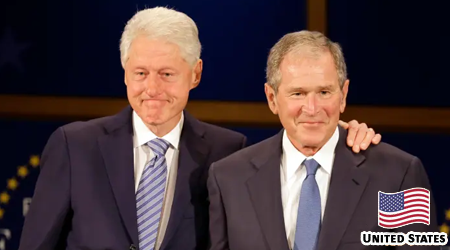
George H.W. Bush & Bill Clinton
Liberty Medal 2006
George H.W. Bush (the 41st U.S. President) and Bill Clinton (the 42nd) share a legacy defined by an extraordinary transition from fierce political rivals to "brothers from another mother." In 1992, Clinton’s charismatic "New Democrat" platform unseated the incumbent Bush, who had overseen the peaceful end of the Cold War and a decisive victory in the Gulf War but struggled with a sluggish domestic economy.Despite the bruising campaign, Bush famously left a gracious, handwritten note for Clinton in the Oval Office, wishing him "great happiness" and stating, "Your success now is our country's success." Their bond truly blossomed post-presidency when George W. Bush asked them to co-lead relief efforts for the 2004 Indian Ocean tsunami and Hurricane Katrina.Together, they modeled a bipartisan civility that had become rare in Washington. Their partnership raised hundreds of millions for humanitarian causes, proving that shared national service could transcend the deepest political divides.
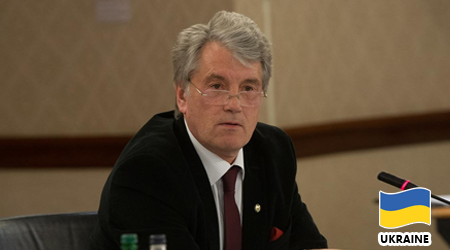
Viktor Yushchenko
Liberty Medal 2005
Viktor Yushchenko served as the third President of Ukraine from 2005 to 2010. A former central banker who oversaw the introduction of the national currency, the hryvnia, Yushchenko rose to political prominence as a pro-Western reformer.His 2004 presidential campaign became a defining moment in modern history. After being mysteriously poisoned with dioxin, which left his face permanently disfigured, he faced a rigged election against the pro-Russian Viktor Yanukovych. This sparked the Orange Revolution, a massive wave of peaceful protests that successfully forced a revote and led to Yushchenko's victory.As president, Yushchenko sought to steer Ukraine toward the European Union and NATO while promoting a distinct Ukrainian national identity. However, his tenure was plagued by economic struggles and bitter infighting with his former ally, Yulia Tymoshenko. By the end of his term, his popularity had faded, but he remains a pivotal figure for his role in Ukraine's democratic awakening.
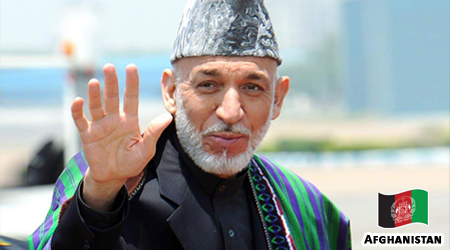
Hamid Karzai
Liberty Medal 2004
Hamid Karzai served as the first democratically elected President of Afghanistan, holding office from 2004 to 2014. A member of the influential Popalzai Pashtun tribe, Karzai emerged as a key figure following the 2001 U.S.-led invasion that toppled the Taliban. He was initially appointed as the chairman of the interim administration before winning the 2004 and 2009 presidential elections.Karzai’s presidency was defined by the immense challenge of rebuilding a war-torn nation while navigating complex tribal politics and a resurgent Taliban insurgency. Internationally, he was lauded for his efforts to unify Afghanistan's diverse ethnic groups; however, his later years were marked by increasingly strained relations with the United States over civilian casualties and corruption allegations. Since the 2021 Taliban takeover, Karzai has remained in Kabul, acting as a rare bridge between the international community and the current de facto government.
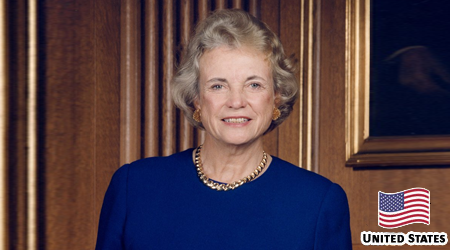
Sandra Day O’Connor
Liberty Medal 2003
Sandra Day O’Connor made history in 1981 when President Ronald Reagan appointed her as the first female justice of the U.S. Supreme Court. Growing up on a remote Arizona cattle ranch, the "Lazy B," she developed a rugged independence that defined her legal career. Despite graduating near the top of her class at Stanford Law, she initially struggled to find work in a male-dominated field, eventually serving as Arizona’s Assistant Attorney General and the nation's first female state senate majority leader.On the Supreme Court, O’Connor became the most powerful woman in America. Known for her pragmatic, case-by-case approach, she was often the "swing vote" on a deeply divided bench. Her centrist influence shaped landmark rulings on affirmative action, voting rights, and reproductive freedom—notably co-authoring the opinion in Planned Parenthood v. Casey. After retiring in 2006, she founded iCivics to promote civic education, cementing her legacy as a trailblazer for both gender equality and judicial moderate-thought.

Colin Powell
Liberty Medal 2002
Colin Powell (1937–2021) was a trailblazing soldier and statesman who became the first African American to serve as National Security Advisor, Chairman of the Joint Chiefs of Staff, and Secretary of State. The son of Jamaican immigrants, Powell rose from the South Bronx to the highest echelons of power through a 35-year Army career, earning two Purple Hearts and rising to the rank of four-star general.He became a national hero as the architect of the "Powell Doctrine," which advocates for the use of overwhelming force and clear exit strategies, a philosophy that guided the decisive 1991 Gulf War victory. However, his legacy is inextricably linked to his 2003 speech at the United Nations, where he presented faulty intelligence regarding weapons of mass destruction to justify the invasion of Iraq—a moment he later called a "blot" on his record. Despite this controversy, Powell remained one of America’s most respected public figures, celebrated for his bipartisan integrity and commitment to service.
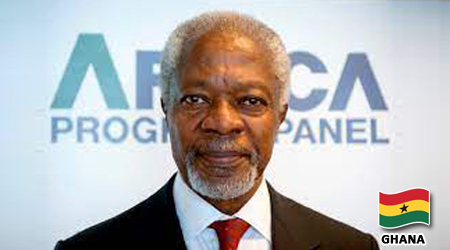
Kofi Annan
Liberty Medal 2001
Kofi Annan (1938–2018) was a Ghanaian diplomat who served as the seventh Secretary-General of the United Nations from 1997 to 2006. He was the first person to rise through the ranks of the UN staff to its highest office and the first from sub-Saharan Africa to hold the position.Annan is most celebrated for his "quiet diplomacy" and his commitment to human rights. In 2001, he and the United Nations were jointly awarded the Nobel Peace Prize for their work in revitalizing the organization and prioritizing global health. He was a driving force behind the Millennium Development Goals and played a crucial role in establishing the Global Fund to fight AIDS, Tuberculosis, and Malaria.Despite his successes, his tenure faced challenges, including the Oil-for-Food scandal and criticism over the UN's failure to prevent the Rwandan genocide during his time as head of peacekeeping. Nevertheless, he remained a respected global mediator until his death, famously leading peace efforts in Kenya and Syria.
Liberty Medal Laureates (2000 ~ 1996)
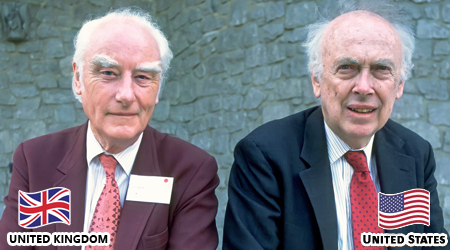
Dr. James D. Watson & Dr. Francis Crick
Liberty Medal 2000
In 1953, James Watson and Francis Crick fundamentally changed our understanding of biology by discovering the double helix structure of DNA. Working at Cambridge University’s Cavendish Laboratory, they built physical models to solve the mystery of how genetic information is stored and replicated.Shutterstock
ExploreTheir breakthrough relied on synthesizing disparate clues, including Chargaff’s Rules (which noted that Adenine equals Thymine and Guanine equals Cytosine) and, crucially, X-ray diffraction images from King’s College London. Specifically, "Photo 51," taken by Rosalind Franklin and shown to Watson by Maurice Wilkins without her knowledge, provided the vital evidence of a helical shape.Their elegant model showed two antiparallel strands with nitrogenous bases pairing in the center, famously noting that this pairing "immediately suggests a possible copying mechanism." For this, Watson, Crick, and Wilkins shared the 1962 Nobel Prize. While their discovery launched the era of modern genetics, the omission of the late Franklin from the Nobel honors remains one of science's most enduring controversies.

Kim Dae-jung
Liberty Medal 1999
Kim Dae-jung (1924–2009), often called the "Nelson Mandela of Asia," was a courageous champion of democracy and the eighth President of South Korea. His life was a testament to resilience; as a prominent opposition leader during South Korea's military dictatorships, he survived five assassination attempts—including a dramatic 1973 kidnapping at sea—and was even sentenced to death before his sentence was commuted.Elected president in 1997, Kim led South Korea through the devastating Asian financial crisis and famously pioneered the "Sunshine Policy." Based on the idea that engagement is more effective than confrontation, this policy sought to thaw relations with North Korea through economic cooperation and humanitarian aid. His efforts culminated in the historic 2000 Inter-Korean Summit with Kim Jong Il, the first meeting between leaders of the two nations since the Korean War. For his lifelong struggle for human rights and his peace initiatives, he was awarded the Nobel Peace Prize in 2000.
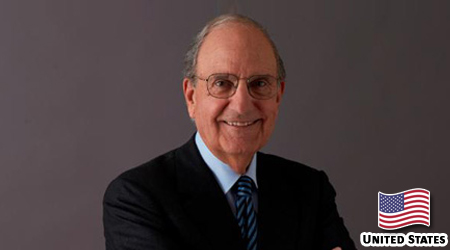
George Mitchell
Liberty Medal 1998
George Mitchell is a distinguished American statesman and former Senate Majority Leader (1989–1995) known for his extraordinary patience and diplomatic skill. After a successful legislative career in which he spearheaded the Americans with Disabilities Act and the Clean Air Act, Mitchell achieved global acclaim as the primary architect of the 1998 Good Friday Agreement.Appointed by President Bill Clinton as a special envoy, Mitchell chaired the arduous peace negotiations in Northern Ireland for over two years. He famously established the "Mitchell Principles" of non-violence, which provided the framework for all-party talks. His persistence in navigating sectarian divides eventually ended "The Troubles," earning him the Presidential Medal of Freedom.Beyond Northern Ireland, he served as a Middle East envoy and conducted high-profile investigations, most notably the "Mitchell Report" on the use of performance-enhancing drugs in Major League Baseball. His career exemplifies a lifelong commitment to the rule of law and peaceful conflict resolution.
View More
CNN International
Liberty Medal 1997
CNN International (CNNI) is a premier global 24-hour news network, reaching over 320 million households and hotel rooms across more than 200 countries. Launched in 1985 by Ted Turner, it was initially a simulcast of the domestic U.S. feed but evolved into a distinct entity to compete with broadcasters like the BBC.While its sister channel, CNN (U.S.), focuses heavily on American politics, CNNI prioritizes international affairs, business, and global health. This global focus gave rise to the "CNN Effect," a political theory suggesting that the network’s real-time coverage of international crises—like the Gulf War or the famine in Ethiopia—can compel world leaders to take immediate diplomatic or military action.Headquartered in Atlanta but with major hubs in London, Hong Kong, and Abu Dhabi, CNNI operates via five regional feeds to tailor content to local time zones. Despite facing competition from Al Jazeera and social media, it remains a cornerstone of global journalism, recognized for its commitment to breaking news and investigative reporting.
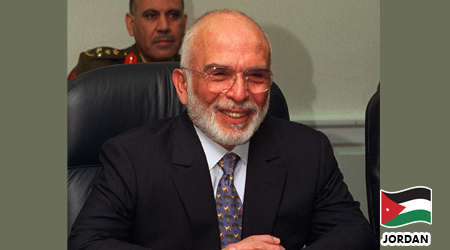
King Hussein
Liberty Medal 1996
King Hussein bin Talal of Jordan (1935–1999) was one of the 20th century’s most resilient and respected statesmen. Ascending the throne at just 17 after his grandfather's assassination and his father's abdication, he guided Jordan through nearly 47 years of regional upheaval, earning the title "Al-Malik Al-Insan" (The Humane King).His reign was a masterclass in geopolitical balancing. Despite losing the West Bank in the 1967 Six-Day War and facing internal threats during Black September, Hussein transformed Jordan into a stable, modern state with high standards of education and healthcare. A 40th-generation direct descendant of the Prophet Muhammad, he used his religious and political authority to champion moderation.His crowning achievement was the 1994 Israel–Jordan peace treaty, making Jordan only the second Arab nation to formalize peace with Israel. Even in his final days, while battling cancer, he brokered the Wye River Memorandum, cementing his legacy as a tireless peacemaker who prioritized dialogue over conflict.
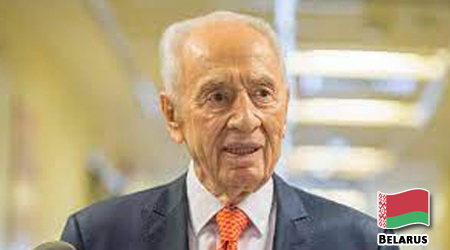
Shimon Peres
Liberty Medal 1996
Shimon Peres (1923–2016) was a titan of Israeli politics whose seven-decade career mirrored the history of the state itself. As the last of Israel’s founding fathers to hold office, he served as both Prime Minister (twice) and as the country's ninth President.Initially a security hawk, Peres was the secret architect of Israel’s nuclear program and defense industry in the 1950s. However, he underwent a dramatic transformation into a tireless "peacemaker-in-chief." This shift culminated in the 1993 Oslo Accords, for which he was awarded the Nobel Peace Prize alongside Yitzhak Rabin and Yasser Arafat.Even in his 80s and 90s, Peres remained a "grandfatherly" figure of optimism, founding the Peres Center for Peace and Innovation to foster regional cooperation through technology. While his legacy remains debated domestically, he is globally remembered as a visionary who believed that "imagination is more important than memory."
Liberty Medal Laureates (1995 ~ 1989)
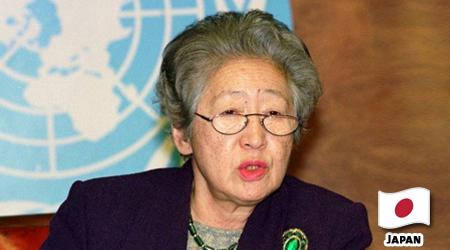
Sadako Ogata
Liberty Medal 1995
Sadako Ogata (1927–2019) was a trailblazing Japanese diplomat and academic who served as the United Nations High Commissioner for Refugees (UNHCR) from 1991 to 2000. She was the first woman, the first Japanese person, and the first academic to lead the agency.Known for her "diminutive stature but giant resolve," Ogata led the UNHCR during one of its most turbulent decades, navigating crises in the Balkans, Rwanda, and the former Soviet Union. She famously expanded the agency’s mandate by deciding to protect internally displaced persons (IDPs)—notably Kurds in northern Iraq—arguing that the UN must protect people where they are, regardless of borders.Later, as President of the Japan International Cooperation Agency (JICA), she pioneered the concept of "human security," shifting the focus from state-centric defense to the protection and empowerment of individuals. Her legacy is one of fearless field presence and an unwavering commitment to humanitarian principles.
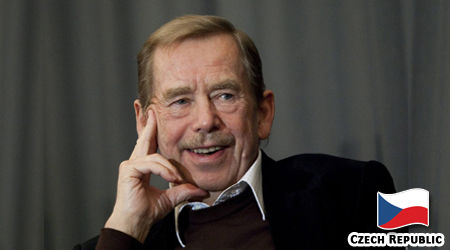
Vaclav Havel
Liberty Medal 1994
Václav Havel (1936–2011) was a Czech playwright, dissident, and statesman who became the symbol of moral resistance against totalitarianism. Born into a wealthy family, he was denied formal education by the Communist regime but rose to fame as an absurdist playwright. His 1978 essay, "The Power of the Powerless," famously urged citizens to "live in truth" rather than cooperate with the state's lies.As a co-founder of Charter 77, Havel endured years of imprisonment and surveillance. His persistence bore fruit during the 1989 Velvet Revolution, a peaceful uprising that toppled Communism in Czechoslovakia. Within weeks of his final release from prison, Havel was elected the nation's first democratic president since 1948.He served as the final President of Czechoslovakia and the first President of the Czech Republic, overseeing the country’s transition to a market economy and its entry into NATO. Havel remains a global icon of human rights, remembered for his belief that love and truth must eventually prevail over hatred and lies.
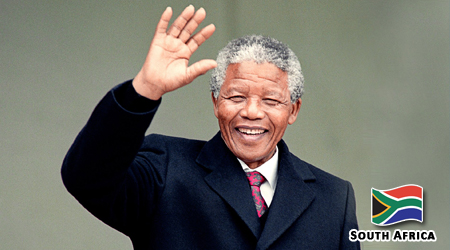
Nelson Mandela
Liberty Medal 1993
Nelson Mandela (1918–2013), known affectionately as Madiba, was the towering figure of the struggle against apartheid and South Africa’s first Black president. Originally a lawyer, Mandela joined the African National Congress (ANC) in 1944. After years of non-violent protest were met with state brutality, he co-founded the militant wing, Umkhonto we Sizwe, leading to his 1962 arrest.Mandela spent 27 years in prison, mostly on Robben Island, becoming the world’s most famous political prisoner and a global symbol of resistance. Released in 1990 by President F.W. de Klerk, he chose reconciliation over revenge. He shared the 1993 Nobel Peace Prize with de Klerk for peacefully dismantling apartheid.As president (1994–1999), Mandela established the Truth and Reconciliation Commission to heal a fractured nation. His legacy as the "Father of the Nation" remains a testament to the power of forgiveness and the triumph of the human spirit.
View More
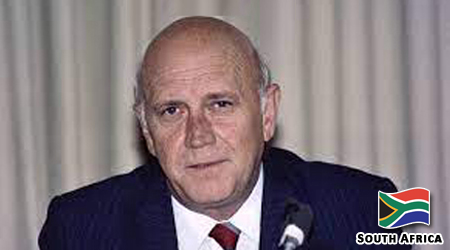
Frederik-Willem-de-Klerk
Liberty Medal 1993
Frederik Willem de Klerk (1936–2021) was the final State President of apartheid-era South Africa, serving from 1989 to 1994. Born into a prominent Afrikaner political family, he was initially considered a conservative; however, upon taking office, he recognized that the country was on the brink of a catastrophic racial civil war.In a landmark 1990 speech, de Klerk stunned the world by lifting the ban on the African National Congress (ANC) and ordering the release of Nelson Mandela. He subsequently worked with Mandela to negotiate a new constitution, ending decades of institutionalized white-minority rule. For these efforts, the two leaders were jointly awarded the Nobel Peace Prize in 1993.His legacy remains complex. While he is credited with averting a bloodbath, many anti-apartheid activists criticized him for what they viewed as a late and qualified apology for the crimes of apartheid. Conversely, some white conservatives viewed his reforms as a betrayal. After the 1994 elections, he served as Deputy President under Mandela before retiring from politics in 1997.
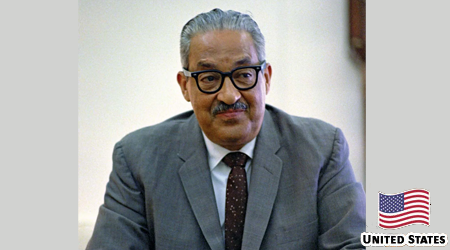
Thurgood Marshall
Liberty Medal 1992
Thurgood Marshall (1908–1993) was a titan of the American legal system and a central architect of the Civil Rights Movement. Known as "Mr. Civil Rights," he spent decades dismantling the "separate but equal" doctrine as the chief counsel for the NAACP. His crowning achievement as a lawyer was the landmark 1954 Brown v. Board of Education case, in which he successfully argued that racial segregation in public schools was unconstitutional.In 1967, President Lyndon B. Johnson appointed Marshall as the first African American justice of the U.S. Supreme Court. Over his 24-year tenure, he remained a steadfast liberal voice, championing the rights of the vulnerable, advocating for affirmative action, and consistently opposing the death penalty.Marshall’s journey from being denied admission to the University of Maryland Law School due to his race to sitting on the nation's highest bench remains a powerful symbol of justice. He is remembered for his unwavering belief that the law could—and should—be used as a tool for social progress.

Médecins Sans Frontières
Liberty Medal 1991
Médecins Sans Frontières (MSF), or Doctors Without Borders, is an international medical humanitarian organization that provides emergency aid to people affected by armed conflict, epidemics, and natural disasters. Founded in 1971 by a small group of French doctors and journalists, it was born out of the frustration with the neutrality of the Red Cross during the Biafran famine, leading the founders to prioritize both medical action and témoignage (bearing witness).Operating in over 70 countries, MSF is governed by the principles of impartiality, independence, and neutrality. Because over 90% of its funding comes from private donors, the organization can act swiftly and speak out against human rights abuses without fear of government retribution. In 1999, MSF was awarded the Nobel Peace Prize for its pioneering humanitarian work. The organization used the prize money to establish the Drugs for Neglected Diseases initiative (DNDi), focusing on treatments for diseases that pharmaceutical companies often overlook.
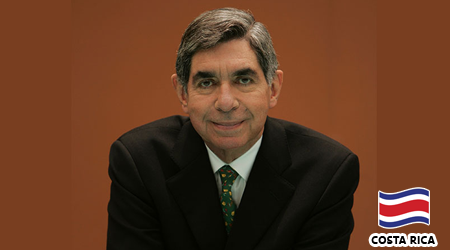
Oscar Arias Sanchez
Liberty Medal 1991
Óscar Arias Sánchez (born 1940) is a celebrated Costa Rican statesman and two-time president (1986–1990 and 2006–2010) best known for his diplomatic courage. In 1987, he was awarded the Nobel Peace Prize for his pivotal role in drafting and promoting the Esquipulas II Peace Accord.At a time when Central America was ravaged by Cold War proxy conflicts and civil wars, Arias famously "locked the door" during a summit in Guatemala City, insisting that the presidents of Guatemala, El Salvador, Honduras, and Nicaragua reach an agreement. His plan successfully advocated for democracy, free elections, and an end to foreign interference, effectively sidelining the military influence of global superpowers.Arias used his Nobel prize money to establish the Arias Foundation for Peace and Human Progress, focusing on demilitarization and gender equality. During his second term, he championed the Costa Rica Consensus, aiming to reward developing nations that prioritize social investment over military spending. His leadership remains a testament to the belief that small nations can exercise significant moral authority on the world stage.
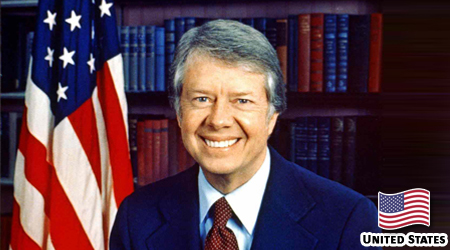
Jimmy Carter
Liberty Medal 1990
Jimmy Carter (1924–2024), the 39th U.S. President, is remembered as a man of deep faith and "the best former president in history." A Georgia peanut farmer and nuclear-trained Naval officer, he entered the White House in 1977 as a Washington outsider.His presidency was marked by historic triumphs, notably the Camp David Accords, which brought peace between Egypt and Israel, and the normalization of relations with China. However, his domestic tenure struggled against "stagflation" and the 444-day Iran Hostage Crisis, which contributed to his 1980 defeat.In his unprecedented 40-year post-presidency, Carter founded The Carter Center, dedicated to conflict resolution and disease eradication—nearly eliminating the Guinea worm parasite. His lifelong commitment to human rights and volunteering for Habitat for Humanity earned him the Nobel Peace Prize in 2002. He died in 2024 at the age of 100, leaving a legacy of humilty and service.

Lech Walesa
Liberty Medal 1989
Lech Wałęsa (born 1943) is a Polish statesman and labor activist who served as the first democratically elected President of Poland (1990–1995). An electrician by trade at the Gdańsk Shipyard, he became the charismatic face of the Solidarity (Solidarność) movement, the first independent trade union in the Soviet bloc.In 1980, Wałęsa famously climbed the shipyard fence to lead a strike that forced the Communist regime to grant workers the right to organize. Despite facing imprisonment and the imposition of martial law in 1981, he remained a symbol of non-violent resistance. His efforts were recognized globally with the 1983 Nobel Peace Prize, which his wife, Danuta, accepted on his behalf while he remained in Poland to continue the struggle.Wałęsa was instrumental in the 1989 Round Table Talks, which led to peaceful semi-free elections and the eventual collapse of Communism in Eastern Europe. His transition from a shipyard worker to a world leader remains a definitive chapter in the fall of the Iron Curtain.