


European Medal of Tolerance

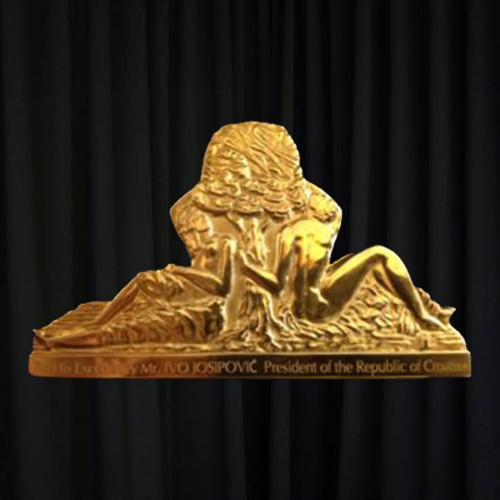
European Medal of Tolerance
The European Medal of Tolerance is a medal established by the European Council on Tolerance and Reconciliation (ECTR) in 2008.The purpose of the prize is to honour and reward extraordinary creative achievements in the promotion of tolerance. The ultimate aim is to draw attention to successful undertakings that can serve as models in the field of tolerance and peace-building. The prize thus recognizes effectiveness as well as vision; impact assessment is a part of the decision process.This prize is dedicated to effective implementation of the Principles of Tolerance in public and private spheres, in particular in the policy making process, legislative action on the national and regional level and law enforcement activities as well as in the arts, education, culture, science and communication.The prize is to be awarded to persons, groups of persons, non-governmental, governmental and intergovernmental organizations and institutions for exceptional contributions to and leadership in, the promotion of tolerance on the European continent and to the fight against intolerance such as xenophobia, anti-Semitism, aggressive nationalism, political extremism and racially motivated hate crime.The prize may be awarded to the families of outstanding individuals who have lost their lives in the struggle against intolerance.The prize is a gold 'European Medal of Tolerance' presented to the recipient as a concrete and lasting token of the award.
| Sl | Name | Country | Flag | Year | Awarded For |
|---|---|---|---|---|---|
| 8 | Albert Alexandre Louis Pierre Grimaldi | Morroco | 2017 | people who risk serious injury or death while saving or attempting to save the lives of others | |
| 7 | Andrei Konchalovsky | Russia | 2016 | people who risk serious injury or death while saving or attempting to save the lives of others | |
| 6 | Martin Schulz | Germany | 2016 | people who risk serious injury or death while saving or attempting to save the lives of others | |
| 5 | Samuel Eto’o | Camerron | 2015 | people who risk serious injury or death while saving or attempting to save the lives of others | |
| 4 | FARE Network | Austria | 2015 | people who risk serious injury or death while saving or attempting to save the lives of others | |
| 3 | Ivo Josipovi? | Crotia | 2012 | people who risk serious injury or death while saving or attempting to save the lives of others | |
| 2 | Boris Tadi? | Serbia | 2012 | people who risk serious injury or death while saving or attempting to save the lives of others | |
| 1 | H.M. Juan Carlos I | Spain | 2010 | people who risk serious injury or death while saving or attempting to save the lives of others |
European Medal of Tolerance Laureates (2020 ~ 2010)

Albert II, Prince of Monaco
European Medal of Tolerance 2017
Albert II, Prince of Monaco, has redefined the role of a modern monarch by placing humanity and environmental peace at the center of his sovereignty. While many leaders focus on geopolitical strategy, Albert II approaches peace through the lens of sustainability and planetary health, recognizing that resource scarcity is a primary driver of global conflict.In 2015, the Prince was awarded the European Medal of Tolerance for his "unwavering commitment to the preservation of the planet" and his efforts to bridge cultural divides. His philosophy is rooted in the idea that humanity cannot thrive in a broken ecosystem. By championing the protection of the oceans and fighting climate change through the Prince Albert II of Monaco Foundation, he advocates for the most vulnerable populations who are first to suffer from ecological displacement.His leadership is characterized by:Scientific Diplomacy: Using research as a neutral ground for international cooperation.Humanitarian Aid: Providing consistent support for refugees and disaster relief.Intercultural Dialogue: Promoting Monaco as a crossroads for peaceful exchange between nations.Ultimately, Albert II views peace not merely as the absence of war, but as a proactive, harmonious relationship between humanity and the natural world.

Andrei Konchalovsky
European Medal of Tolerance 2016
The 2016 European Medal of Tolerance in the area of culture is granted to Andrei Konchalovsky, a Russian film director, producer and screenwriter.Throughout His professional career Andrei Konchalovsky has shown deep understanding and sensibility towards human tragedies. History has been the source of inspiration for Him to draw universal lessons for humanity. He is perhaps best known for his latest movie, the Holocaust drama “Paradise”. In 2016 this movie won the Silver Lion at the 73rd Venice International Film Festival. In December 2016 it was shortlisted in the nine films to be considered for the 89th OSCAR Academy Award.“The Medal goes to Andrei Konchalovsky because of his lifelong achievements in the area of remembrance of human tragedies”, emphasized Kantor. “Extremists are using and manipulating the past to serve their own agenda, and it is an important role of people in the arts and culture to stand against extremism and provide those of us who did not experience the past with teachable moments for the present and the future which Andrei has done.”

Martin Schulz
European Medal of Tolerance 2016
Martin Schulz, former President of the European Parliament, was awarded the European Medal of Tolerance in 2016 for his tireless defense of democratic values and his firm stance against extremism. As a leader who grew up near the intersection of the German, Dutch, and Belgian borders, Schulz views the European Union not as a bureaucratic entity, but as a "miracle" of peace and reconciliation.His commitment to humanity is defined by:Combating Intolerance: Schulz has been a vocal opponent of xenophobia and anti-Semitism, famously warning that the "demons of the past" still threaten modern social cohesion.Democratic Legitimacy: He championed the idea that peace is only sustainable through citizen engagement, fighting to make European institutions more transparent and accountable to the people.Diplomacy and Human Rights: Throughout his tenure, he prioritized human rights in EU foreign policy, facilitating delicate dialogues in conflict-prone regions.For Schulz, tolerance is the "endurance" of different opinions and a fundamental respect for others regardless of origin. By positioning the European Parliament as a bulwark against radical nationalism, he has reinforced the continent’s commitment to a shared, peaceful future.
View More

Samuel Eto’o
European Medal of Tolerance 2015
Samuel Eto’o, the legendary Cameroonian striker and four-time African Player of the Year, was awarded the European Medal of Tolerance in 2015 for his "personal leadership and devotion to combating racism." Eto’o holds the unique distinction of being a recipient whose activism was forged in the heat of professional competition.Having faced systemic racial abuse throughout his career in Europe’s top leagues, Eto’o famously chose to "stand up and shout" rather than endure in silence. A defining moment occurred in 2006 while playing for Barcelona, when he attempted to walk off the pitch in response to monkey chants from Zaragoza fans—a radical act that forced a global conversation on athlete rights and dignity.His commitment to humanity extends through:The Samuel Eto’o Foundation: Providing healthcare, education, and sports opportunities to disadvantaged youth in Africa.Moral Leadership: Using his platform to urge fellow players and authorities to take a "moral stand" against hate.Global Advocacy: Fighting for social inclusion and proving that football can be a unifier rather than a divider.For Eto’o, tolerance is not passive acceptance but a proactive struggle to ensure the next generation of players never has to choose between their passion and their humanity.

FARE Network
European Medal of Tolerance 2015
The FARE Network (Football Against Racism in Europe) was honored with the European Medal of Tolerance in 2015, sharing the distinction with football icon Samuel Eto’o. This award recognized FARE's expansive role as a "network of networks" dedicated to purging discrimination from the world's most popular sport.Founded in 1999, FARE acts as the primary watchdog and advocacy body for social inclusion in European football. Its impact is rooted in:Grassroots Empowerment: Supporting hundreds of local fan groups and NGOs to combat xenophobia, homophobia, and ultra-nationalism.Systemic Change: Partnering with UEFA and FIFA to implement monitoring systems at major international matches to identify and report discriminatory behavior.The "Football People" Weeks: Organizing one of the largest social message campaigns in sport, uniting thousands of activists, clubs, and players annually.By transforming stadiums from sites of potential conflict into arenas of shared humanity, the FARE Network proves that sport can be a powerful engine for peace and cross-cultural understanding.

Ivo Josipović
European Medal of Tolerance 2012
Ivo Josipović, the former President of Croatia (2010–2015), was awarded the European Medal of Tolerance in 2012 for his significant efforts in post-war reconciliation and regional stability. A legal scholar and classical composer by training, Josipović utilized his presidency to foster a culture of dialogue in South East Europe, notably working alongside Serbian leaders to heal the wounds of the 1990s conflicts.His contribution to humanity is characterized by:Regional Reconciliation: Leading peace initiatives aimed at building mutual trust between former adversaries in the Balkan region.Human Rights Advocacy: Championing the protection of minority rights and individual liberties as a cornerstone of Croatian democracy.Justice and Accountability: Leveraging his expertise in international criminal law to address war crimes and combat systemic corruption.Cultural Diplomacy: Promoting the idea that the European Union serves as a vital peacemaker and a "common European home" for all neighboring states.By prioritizing transparency and social empathy, Josipović helped guide Croatia toward EU membership, viewing the Union as the ultimate symbol of lasting peace.

Boris Tadić
European Medal of Tolerance 2012
Boris Tadić, the former President of Serbia (2004–2012), was awarded the European Medal of Tolerance in 2012 for his courageous role in fostering regional reconciliation in the Balkans. Recognized alongside Croatia's Ivo Josipović, Tadić was honored for his "significant contribution to the promotion of tolerance" and his dedication to transforming a region historically scarred by conflict.
+1His legacy of humanity and peace is defined by several pivotal actions:The Power of Apology: Tadić broke long-standing taboos by offering official apologies to Bosnia and Herzegovina (2004) and Croatia (2007) for crimes committed in the name of the Serbian people during the 1990s wars.Commemoration: In 2005, he became the first Serbian leader to visit the Srebrenica Genocide Memorial, signaling a profound moral shift toward recognizing historical truths.Justice and Cooperation: Under his leadership, Serbia captured and extradited high-profile war crimes suspects to the ICTY, fulfilling a critical requirement for international justice and European integration.Tadić’s philosophy treats tolerance as an active pursuit of "mutual trust" rather than mere coexistence. By championing a democratic, pro-European Serbia, he helped replace the rhetoric of radical nationalism with a vision of a shared, peaceful future in the "common European home."
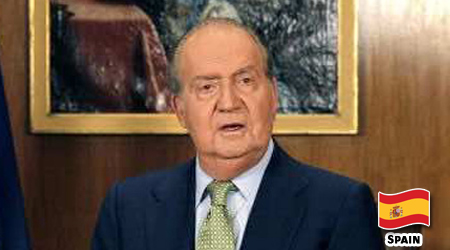
H.M. Juan Carlos I
European Medal of Tolerance 2010
H.M. King Juan Carlos I of Spain was the inaugural recipient of the European Medal of Tolerance in 2010, honored for his "lifelong dedication to the issue of tolerance and political reconciliation." His legacy is fundamentally tied to the Spanish Transition, where he steered the nation from the shadows of Francisco Franco’s dictatorship toward a stable, modern democracy.His humanitarian impact is defined by:The "Engine of Change": Eschewing the absolute power he inherited, Juan Carlos I prioritized the Reconciliación Nacional, choosing to be a king for all Spaniards regardless of their political past.Defending Democracy: His decisive televised address during the 1981 coup attempt (23-F) is credited with saving Spain’s young democracy, signaling that the crown would not tolerate a return to authoritarianism.Interfaith Dialogue: He played a critical role in normalizing Spain’s relationship with the Jewish world and Israel, seeking to heal centuries-old historical ruptures.By championing a "consensus-based" peace, Juan Carlos I transformed Spain into a symbol of how societies can peacefully transition from division to unity through the values of tolerance and mutual respect.