


Niwano Peace Prize


Niwano Peace Prize
The Foundation established the Niwano Peace Prize to honor and encourage those who are devoting themselves to interreligious cooperation in the cause of peace, and to make their achievements known as it is Foundation’s hope that this prize will further promote interreligious cooperation for peace and lead to the emergence of ever more people devoting themselves to this cause.
| Sl | Name | Country | Flag | Year | Awarded For |
|---|---|---|---|---|---|
| 42 | Musawah | Malaysia | 2025 | inter-religious cooperation in the cause of peace. | |
| 41 | Mohammed Abu-Nime | Palestine | 2024 | inter-religious cooperation in the cause of peace. | |
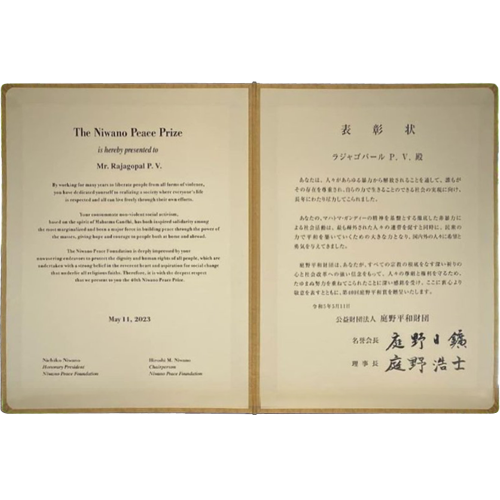
| 40 | Rajagopal P. V. | India | 2023 | inter-religious cooperation in the cause of peace. | |
| 39 | Michael Lapsley | South Africa | 2022 | inter-religious cooperation in the cause of peace. | |
| 38 | Venerable Shih Chao-hwei | Taiwan | 2021 | inter-religious cooperation in the cause of peace. | |
| 37 | Ven. Pomnyun Sunim | South Korea | 2020 | inter-religious cooperation in the cause of peace. | |
| 36 | John Paul Lederach | United States | 2019 | inter-religious cooperation in the cause of peace. | |
| 35 | Adyan Foundation | Lebanon | 2018 | inter-religious cooperation in the cause of peace. | |
| 34 | Munib Younan | Palestine | 2017 | inter-religious cooperation in the cause of peace. | |
| 33 | Center for Peace Building and Reconciliation (CPBR) | Sri Lanka | 2016 | inter-religious cooperation in the cause of peace. | |
| 32 | Esther Ibanga | Nigeria | 2015 | inter-religious cooperation in the cause of peace. | |
| 31 | Dena Merriam | United States | 2014 | inter-religious cooperation in the cause of peace. | |
| 30 | Gunnar Stålsett | Norway | 2013 | inter-religious cooperation in the cause of peace. | |
| 29 | Rosalina Tuyuc | Guatemala | 2012 | inter-religious cooperation in the cause of peace. | |
| 28 | Sulak Sivaraksa | Thailand | 2011 | inter-religious cooperation in the cause of peace. | |
| 27 | Ela Bhatt | India | 2010 | inter-religious cooperation in the cause of peace. | |
| 26 | Reverend Canon Gideon Byamugisha | Uganda | 2009 | inter-religious cooperation in the cause of peace. | |
| 25 | Prince El Hassan bin Talal | Jordan | 2008 | inter-religious cooperation in the cause of peace. | |
| 24 | Master Cheng Yen (Tzu-Chi, the Buddhist Compassion Relief Tzu-Chi Foundation) | Taiwan | 2007 | inter-religious cooperation in the cause of peace. | |
| 23 | Rabbis for Human Rights | Israel | 2006 | inter-religious cooperation in the cause of peace. | |
| 22 | Dr. Hans Küng | Switzerland | 2005 | inter-religious cooperation in the cause of peace. | |
| 21 | Acholi Religious Leaders Peace Initiative (ARLPI) | Uganda | 2004 | inter-religious cooperation in the cause of peace. | |
| 20 | Dr. Scilla Elworthy | United Kingdom | 2003 | inter-religious cooperation in the cause of peace. | |
| 19 | Samuel Ruiz García, Bishop Emeritus of San Cristobal de las Casas | Mexico | 2002 | inter-religious cooperation in the cause of peace. | |
| 18 | Elias Chacour, bishop of the Melkite-Catholic Chuch | Israel | 2001 | inter-religious cooperation in the cause of peace. | |
| 17 | Dr. Kang Won Yong | Korea | 2000 | inter-religious cooperation in the cause of peace. | |
| 16 | Community of Sant'Egidio | Italy | 1999 | inter-religious cooperation in the cause of peace. | |
| 15 | Maha Ghosananda | Cambodia | 1998 | inter-religious cooperation in the cause of peace. | |
| 14 | Corrymeela Community | Norhth Ireland | 1997 | inter-religious cooperation in the cause of peace. | |
| 13 | Marii Hasegawa | United States | 1996 | inter-religious cooperation in the cause of peace. | |
| 12 | M. Aram | India | 1995 | inter-religious cooperation in the cause of peace. | |
| 11 | Cardinal Paulo Evaristo Arns, Archbishop of Sao Paulo | Brazil | 1994 | inter-religious cooperation in the cause of peace. | |
| 10 | Neve Shalom/Wahat al-Salam | Israel | 1993 | inter-religious cooperation in the cause of peace. | |
| 9 | A. T. Ariyaratne | Sri Lanka | 1992 | inter-religious cooperation in the cause of peace. | |
| 8 | Dr. Hildegard Goss-Mayr | Austria | 1991 | inter-religious cooperation in the cause of peace. | |
| 7 | Norman Cousins | United States | 1990 | inter-religious cooperation in the cause of peace. | |
| 6 | Etai Yamada | Japan | 1989 | inter-religious cooperation in the cause of peace. | |
| 5 | World Muslim Congress | Pakistan | 1987 | inter-religious cooperation in the cause of peace. | |
| 4 | Philip A. Potter | Dominican Republic | 1986 | inter-religious cooperation in the cause of peace. | |
| 3 | Zhao Puchu | China | 1985 | inter-religious cooperation in the cause of peace. | |
| 2 | Homer A. Jack | United States | 1984 | inter-religious cooperation in the cause of peace. | |
| 1 | Dom Hélder Câmara | Brazil | 1983 | inter-religious cooperation in the cause of peace. |
Niwano Peace Prize Laureates (2011 ~ 2001)
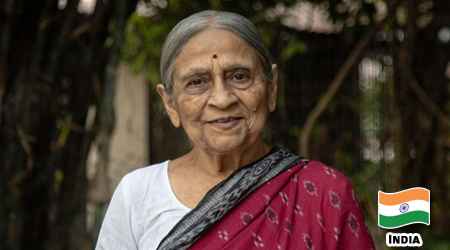
Ela Bhatt
Niwano Peace Prize 2010
Ms. Ela Ramesh Bhatt, a follower of the teachings of Mahatma Gandhi, is widely recognized as one of the world’s most remarkable pioneers and entrepreneurial forces in grassroots development. Known as the “gentle revolutionary,” she has dedicated her life to improving the lives of India’s poorest and most oppressed women workers. In 1972, she founded the Self-Employed Women’s Association (SEWA), a trade union now with more than 1.2 million members. In 1974 she founded the SEWA Cooperative Bank which now has an outreach of 3 million women. She died in 2022.
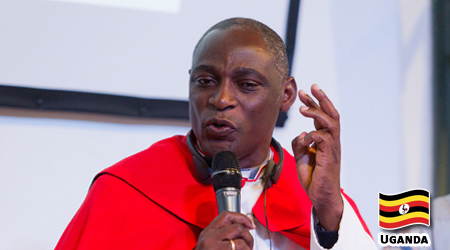
Gideon Byamugisha
Niwano Peace Prize 2009
Rev. Canon Gideon Byamugisha, a Ugandan Anglican priest born in 1959, who learned in 1991 that he was HIV positive. He was the first African priest to declare, publicly, that he himself was HIV positive, breaking one of the most important barriers in the struggle against HIV, that of stigma-induced silence. He is Canon of two cathedrals, one in Uganda and one in Zambia. He has helped to raise public awareness about the disease in a way that has brought distinction to religious and cultural communities in his own country, Uganda, across the African continent, and on a global level.
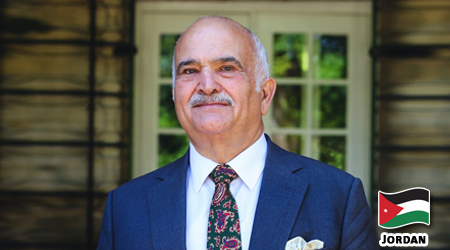
Prince El Hassan bin Talal
Niwano Peace Prize 2008
HRH Prince Hassan has devoted his life to building peace with justice in the Middle East based on his understanding of human dignity informed and inspired by his faith. He has been a bridge builder across existing political and religious divides. HRH Prince Hassan is a well known and respected internationally as a man who translates vision into actions. He is a leading member of several international committees and organizations, including president of the Club of Rome, co-chair of the Independent Commission on Humanitarian Issues.
View More

Cheng Yen
Niwano Peace Prize 2007
Master Cheng Yen was born in 1937 in a small town in central Taiwan. In 1963, the most venerable Master Yin Shun accepted her as his disciple, teaching her to be committed to Buddhism and to all living beings. In 1966, Master Cheng Yen established the Buddhist Compassion Relief Tzu Chi Foundation. Since then she has been deeply involved in worldly affairs with an otherworldly spirit. With a mission of “humanizing Buddhism and bringing bodhisattvas into this world,” Master Cheng Yen and the Tzu Chi Foundation have worked in four major areas—charity, medicine, education, and culture. Since its establishment, the Tzu Chi Foundation has grown steadily under the Master’s guidance. Starting with just 30 members, Tzu Chi has now recruited millions of volunteers in 231 offices in 40 countries. Every day close to 100,000 volunteers carry out the Master’s teaching to help the poor and spread compassion to every dark corner of the world.

Rabbis for Human Rights
Niwano Peace Prize 2006
Founded in 1988, Rabbis for Human Rights is an organization of rabbis in Israel which promotes the Jewish value that all human beings are created in the image of God and entitled to justice, equality and respect. Dedicated to this core Jewish value, RHR defends the human rights of everyone in Israel and in the Territories under Israel control through public education, advocacy, and direct service projects.
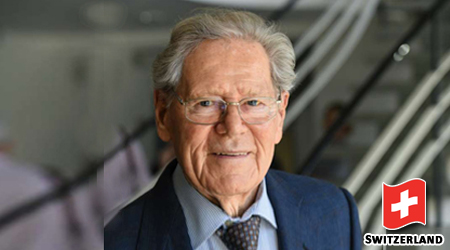
Hans Küng
Niwano Peace Prize 2005
Dr. Hans Kung is widely acknowledged as one of the greatest theologians of the twentieth century. Currently he is President of the Global Ethic Foundation in Germany and Switzerland. He served as official theological consultant to the Second Vatican Council appointed by Pope John XXIII. He drafted the Global Ethic Declaration of the Parliament of the World’s Religions held in Chicago in 1993. He died in 2021.
Acholi Religious Leaders Peace Initiative
Niwano Peace Prize 2004
The ARLPI is an organization in northern Uganda in which the members of different religions, including Islam and Christianity (Catholic, Orthodox, and Anglican), work together. Since its establishment in 1998, it has acted non-violently to end armed conflict, to nurture human resources for the task of creating peace, and to provide assistance to war victims through the work of over 400 volunteers, including its core membership of religious leaders, as well as individual staff members, peace committees in various districts, and peace supporters.
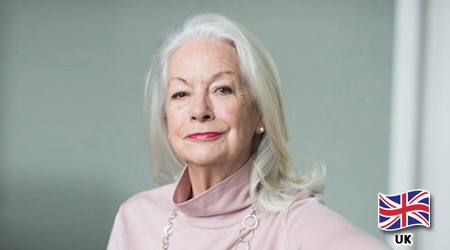
Scilla Elworthy
Niwano Peace Prize 2003
Dr. Elworthy is a Quaker and the founder of the Oxford Research Group, which conducts research on increased security throughout the world by means of nuclear disarmament and the regulation and reduction of weapons exports.”People of all faiths and cultures are discovering in this Iraqi crisis their common bonds of spirit, of care for each other, of care for the planet.” From Dr. Elworthy ‘s acceptance message
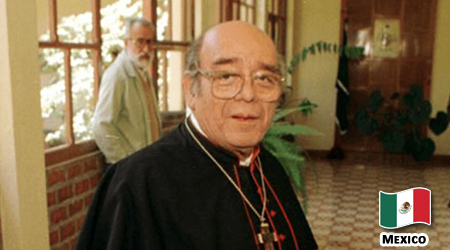
Samuel Ruiz García
Niwano Peace Prize 2002
Roman Catholic Bishop Ruiz has been active in the campaign to protect human rights in Mexico and in Central and South America. He has contributed greatly to the improvement of social conditions in the Mexican state of Indios. He died in 2011. “The poor not only confront us with the dignity of others and the recognition of their being as different,and they also urge us to rebuild our world and ourselves as people.” From Bishop Ruiz’s acceptance speech
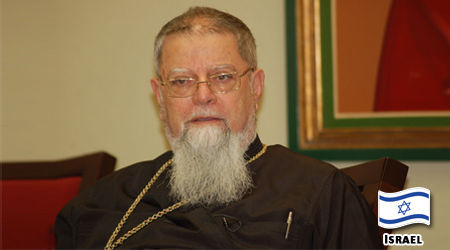
Elias Chacour
Niwano Peace Prize 2001
Father Chacour is a Palestinian Melkite Catholic priest who is dedicated to reconciliation between Jews and Palestinians in Israel through the education of youth at Mar Elias Educational Institutions, which he established in 1982.”Thank goodness we are not copies of one another! It is only when we are different that we can complement each other. It is only when we are different that we can form an orchestra of tolerance, respect, and acceptance.” From Rev. Cliacour’s acceptance speech
Niwano Peace Prize Laureates (2000 ~ 1991)
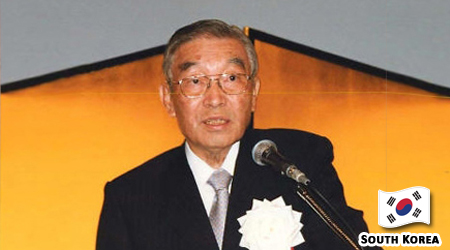
Kang Won Yong
Niwano Peace Prize 2000
A Presbyterian long active in international dialogue among religions, he has worked to implement social justice in his own country and also established the Korean Conference on Religion and Peace in 1986. He died in 2006. “In the twenty-first century, the self-righteous sectors of ‘closed religions’ will most likely accelerate the clash of civilizations. However, hope exists for ‘open religions’ to become a driving force in overcoming such tragic collisions, thus leading us into ‘an era of universal spirituality.’ ” From Dr. Kang’s acceptance speech

Community of Sant'Egidio
Niwano Peace Prize 1999
The community is a lay Catholic organization to assist the weak and the poor. It also has succeeded in mediating conflicts in Africa and other areas. Since 1987 it has annually sponsored international interfaith gatherings in Europe. “Every day all members of Saint Egidio meet the poor and marginalized with… friendship. In fact, we seek not so much to assist or help people as to become brothers and sisters of those whom the Gospel calls the humblest. ” From the acceptance speech by Prof. Andrea Riccardi, president of the Community
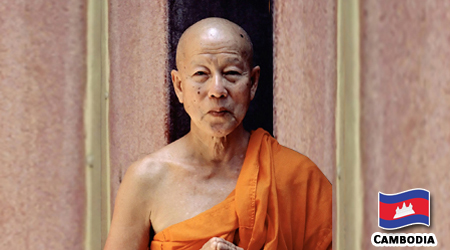
Maha Ghosananda
Niwano Peace Prize 1998
Yen. Maha Ghosananda is a Buddhist leader who has devoted himself to a nonviolence movement to bring lasting peace back to the Cambodian people in the wake of the atrocities of the Pol Pot regime and the subsequent civil war. He died in 2007. “When we suffer, we can meditate step by step until the stopping of suffering. If we want to stop suffering, we have to stop feeling, vedana, that gives rise to greed, anger, and ignorance.” From Vert. Ghosananda’s acceptance speech
View More

Corrymeela Community
Niwano Peace Prize 1997
The community in Northern Ireland has developed grassroots programs to encourage reconciliation there. It not only provided Protestants and Catholics with a site for meeting and conversing, but also offers solace to families of victims of terrorism. “It is not a big political program, though we debate and confront difficult political questions. It is not the solution, for the imitation to a new relationship can never be forced on someone else. It is more like a small candle, glowing in the dark.” From the acceptance speech by Rev. Trevor Williams, leader of the Community
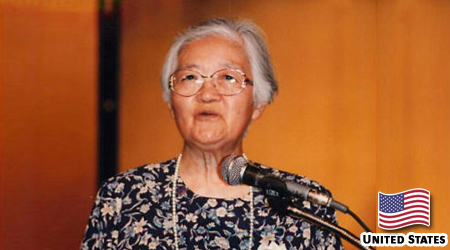
Marii Hasegawa
Niwano Peace Prize 1996
Ms. Hasegawa is leader of the Women’s International League for Peace and Freedom. She has been involved in the promotion of disarmament, the defense of human rights, and the improvement of women’s social status and education. She died in 2012. “Remember that step by step, if we ordinary people all work together, in the end. if not in our lifetime,perhaps in our children’s or their children’s lifetime, we shall have a world of peace, freedom, and justice.” From Ms. Hasegawa ‘s acceptance speech
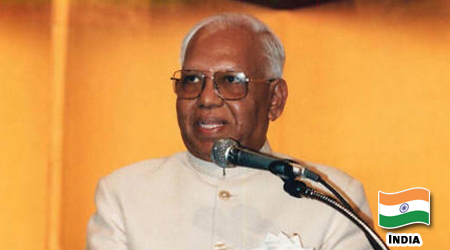
Muthkumaraswamy Aram
Niwano Peace Prize 1995
Dr. Aram was a Hindu dedicated to peace through a variety of means, such as economic development and human rights protection. He founded Shanti Ashram, a movement to improve rural life through education projects, including promotion of literacy. He died in 1997. “Tolerance is the beginning, not the end. Tolerance of religious and cultural differences must lead to mutual respect and positive appreciation. Pluralism, cultural and religious, is a reality ofthe present-day world. We must learn to accept it.” From Dr. Aram v acceptance speech
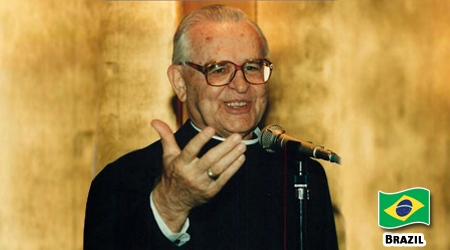
Paulo Evaristo Arns
Niwano Peace Prize 1994
Cardinal Arns. the Roman Catholic archbishop of Sao Paulo, dedicated himself to the democratic process in Brazil under the country’s military regime. His response was create the Justice and Peace Commission in Sao Paulo to safeguard human rights. He died in 2016. “Peace means to love our enemies, forgive those who do not forgive us. and do good to the spiteful, theliars, the prejudiced, the violent. This is a gift from the real Wisdom. Only unconditional love can createthe conditions for peace.” From Cardinal Arn ‘s acceptance speech
Neve Shalom/Wahat al-Salam
Niwano Peace Prize 1993
Neve Shalom/Wahat al-Salam is a joint community ofJews and Palestinians in Israel that has held up the ideal of peaceful coexistence since its establishment in 1972. Its School for Peace offers young Jews and Arabs reconciliation workshops. “We can try in a modest way,…. to do something that may prepare, through education, the emergence of a new generation, in which selfishness and narrow-mindedness will be replaced by love and openness.” From the acceptance speech by Father Bruno Hussar, founder of. Neve Shalom / Wahat al-Salam
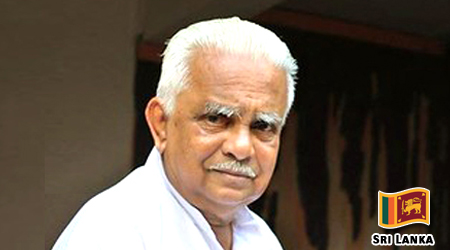
A. T. Ariyaratne
Niwano Peace Prize 1992
Dr. Ariyaratne created and disseminated throughout his country the Sarvodaya Shramadana Movement that emphasizes the ideal of sharing based on the Buddhist spirit. The movement is evaluated highly as a model for rural community development.”I cannot awaken myself unless I help awaken others. Others cannot awaken unless I do. So it is an interconnected and interdependent dual process of awakening oneself and society that we have chosen in the Sarvodaya.” From Dr. Ariyaratne ‘s acceptance speech
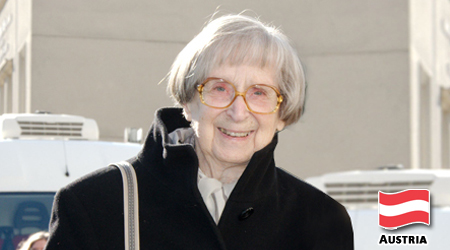
Hildegard Goss-Mayr
Niwano Peace Prize 1991
Dr. Goss-Mayr, a devoted Roman Catholic, is dedicated to peace activities through the International Fellowship of Reconciliation. During the cold war. she concentrated on East-West dialogue in Europe, and later, on nonviolence movements elsewhere.”Who else but the moral authorities and the believing people of our world can show the way out of violence and destruction? What terrible betrayal of our fellow human beings it would be if… we refuse topass on the light and truth that we have received to save mankind.” From Dr. Goss-Mayr’s acceptance speech
Niwano Peace Prize Laureates (1990 ~ 1983)
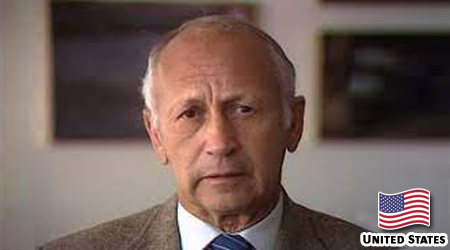
Norman Cousins
Niwano Peace Prize 1990
Dr. Cousins was an advocate of nuclcar disarmament and founded the National Committee for a Sane Nuclear Policy in 1957. He also was dedicated to assisting the politically oppressed and many of Japan’s atomic bombing victims. He died in 1990.”The lesson that needs to be learned by all is that nations are dependent on one another for their well-being in a common organization.” From Dr. Cousins’s acceptance speech
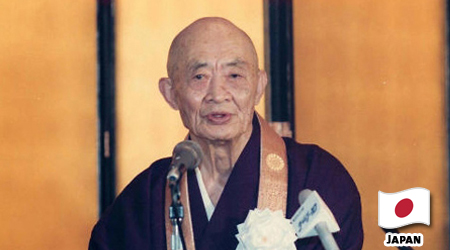
Etai Yamada
Niwano Peace Prize 1989
The late head priest of the Tendai Buddhist denomination made special efforts for interrcligious cooperation and understanding. He hosted the Religious Summit Meeting on Mount Hiei in 1987 in the spirit of the 1986 Day of Prayer for Peace at Assisi. Italy. He died in 1994. “World peace could not be sustained without the united efforts of all people. One can start a war alone, bul the maintenance of world peace requires the cooperation of the whole world.”
World Muslim Congress
Niwano Peace Prize 1987
The Congress haas made numerous efforts to achieve world peace since its establishment in 1926. While promoting dialogue with other religions, it also has offered concrete proposals for ending conflicts in the Middle East and elsewhere. “A world where tension and unrest prevail everywhere, creating suffering, and where the arms race between the major powers has intensified on land and sea and extended into space-this enjoins all those working for peace… to meet, get acquainted, and cooperate.”
View More
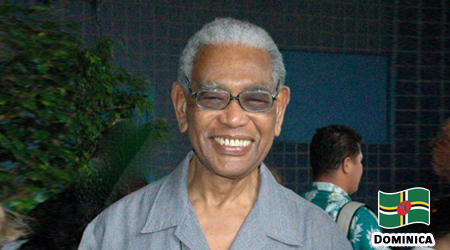
Philip A. Potter
Niwano Peace Prize 1986
A Methodist minister who served in many positions with the World Council of Churches, including as general secretary. He made great contributions in the fields of interreligious dialogue and understanding, as well as disarmament and human rights. He died in 2015. “And to be human is to be in peace—to be fully ourselves and to be open to others with the compassion which seeks the well-being which we share with them as something not to be grasped but to be offered and received.”
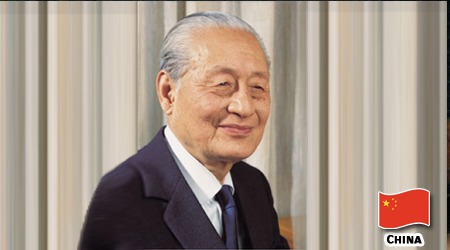
Zhao Puchu
Niwano Peace Prize 1985
The late former president ofthe Buddhist Association of China was dedicated to promoting improvements in social work and public welfare activities in his country, as well as international understanding and cooperation among religions. He died in 2000.”Nor have we people of religion from various parts of the world stood by with folded hands in the face of the threat and challenge of the forces of belligerence, as is irrefutably illustrated by the ceaseless development of the world religious peace movement,…”
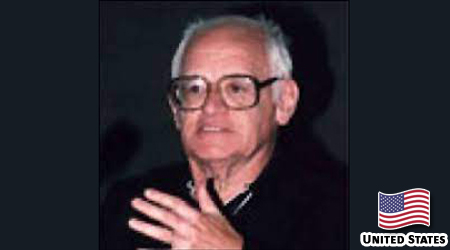
Homer A. Jack
Niwano Peace Prize 1984
Dr.Jack was a Unitarian U’niversalist clergyman and the first secretary general of the World Conference on Religion and Peace. He endeavored to protect human rights and promote disarmament and the abolition of nudear weapons. He died in 1993.”I accept the Niiwano Peace Prize for promoting ‘world peace through interreligious cooperation.’ I do sowith humility. But also I do so with impatience. We have scarcely time to finish the task of abolishing nuclear weapons before these devices of death will soon abolish us.”
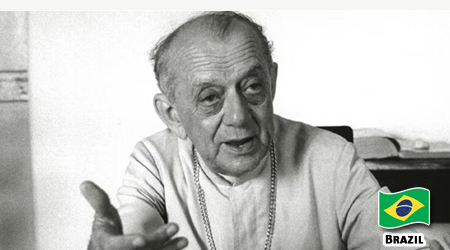
Dom Hélder Câmara
Niwano Peace Prize 1983
Archbishop Camara of the Olincla and Recife diocese was a practitioner of nonviolence who devoted himself to the liberation of Brazilians from oppression and poverty and to increased recognition of their human dignity. He died in 1999. “If all believers in God would receive all other men and women as brothers and sisters, the world would be more respirable and more humane.”