


Public Peace Prize

Public Peace Prize
The Public Peace Prize (PPP), established in 2013 by ordinary citizens, aims to address the lack of recognition for numerous devoted but less visible peacemakers globally. While prestigious awards honor some peace artisans, many individuals and organizations dedicating their lives to resolving conflicts and creating peace conditions remain unknown.The PPP is a citizen-driven, non-cash initiative with the specific mission of raising public awareness for these local, national, and international peacebuilders. Utilizing new media and an open spirit of collaboration, the public can nominate candidates, support those validated on the Prize’s website and social media, and share their profiles. The process concludes with an online celebration, significantly contributing to the recognition and visibility of the laureates for their extraordinary commitment to peace, justice, and reconciliation.
| Sl | Name | Country | Flag | Year | Awarded For |
|---|---|---|---|---|---|
| 49 | Akhand | India | 2020 | for initiatives that have contributed to the culture of peace | |
| 48 | Khowar Academy | Pakistan | 2020 | for initiatives that have contributed to the culture of peace | |
| 47 | Les Artistes pour la Paix | Pakistan | 2020 | for initiatives that have contributed to the culture of peace | |
| 46 | Guillermo Mesa Velasqez | Colombia | 2020 | for initiatives that have contributed to the culture of peace | |
| 45 | Shruti Nagvanshi | India | 2020 | for initiatives that have contributed to the culture of peace | |
| 44 | Marceline Budza | Congo | 2020 | for initiatives that have contributed to the culture of peace | |
| 43 | Monument for Dignity and Memory | Colombia | 2020 | for initiatives that have contributed to the culture of peace | |
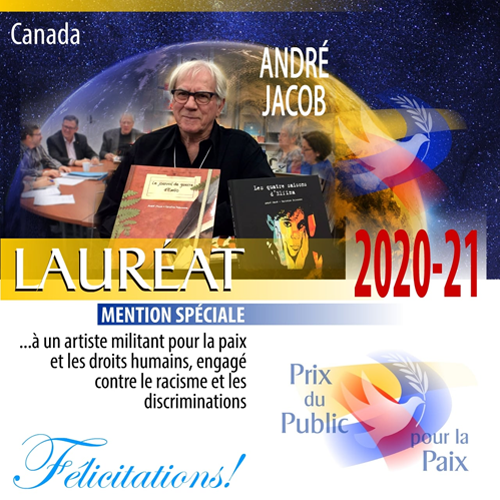
| 42 | André Jacob | France | 2020 | for initiatives that have contributed to the culture of peace | |
| 41 | Arjumand Zaidi | India | 2020 | for initiatives that have contributed to the culture of peace | |
| 40 | Hecho en Libertad | Mexico | 2019 | for initiatives that have contributed to the culture of peace | |
| 39 | Rehmat Aziz Chitrali | Pakistan | 2019 | for initiatives that have contributed to the culture of peace | |
| 38 | SOPEVUDECO | Congo | 2019 | for initiatives that have contributed to the culture of peace | |
| 37 | Etienne De Jonghe | Belgium | 2019 | for initiatives that have contributed to the culture of peace | |
| 36 | Ríos Vivos | Colombia | 2019 | for initiatives that have contributed to the culture of peace | |
| 35 | Zakaria El Hamel | Morocco | 2019 | for initiatives that have contributed to the culture of peace | |
| 34 | World Day of the Boy Child | Western Sahara | 2019 | for initiatives that have contributed to the culture of peace | |
| 33 | Maria del Carmen Fuentes Quesada | Mexico | 2018 | for initiatives that have contributed to the culture of peace | |
| 32 | Lenin Raghuvanshi | India | 2018 | for initiatives that have contributed to the culture of peace | |
| 31 | Dur Khan | Pakistan | 2018 | for initiatives that have contributed to the culture of peace | |
| 30 | Inés Palomeque | Argentina | 2018 | for initiatives that have contributed to the culture of peace | |
| 29 | Nilanjana Sanyal | India | 2018 | for initiatives that have contributed to the culture of peace | |
| 28 | David and Renate Jakupca | United States | 2018 | for initiatives that have contributed to the culture of peace | |
| 27 | Safecity | United States | 2018 | for initiatives that have contributed to the culture of peace | |
| 26 | PazalaMujer | Colombia | 2018 | for initiatives that have contributed to the culture of peace | |
| 25 | The Eyes Newspaper | Cameroon | 2018 | for initiatives that have contributed to the culture of peace | |
| 24 | International Men’s Day | Trinidad and Tobago | 2018 | for initiatives that have contributed to the culture of peace | |
| 23 | Mirja Bibi | Pakistan | 2018 | for initiatives that have contributed to the culture of peace | |
| 22 | Timothy Michael Adepoju | Nigeria | 2017 | for initiatives that have contributed to the culture of peace | |
| 21 | PLAZABORDO | Colombia | 2017 | for initiatives that have contributed to the culture of peace | |
| 20 | Zubair Torwali | Pakistan | 2017 | for initiatives that have contributed to the culture of peace | |
| 19 | Khairatul Saidu | Nigeia | 2017 | for initiatives that have contributed to the culture of peace | |
| 18 | Elliot Hillary Dogbe | Ghana | 2017 | for initiatives that have contributed to the culture of peace | |
| 17 | Coraline Parmentier | South Africa | 2017 | for initiatives that have contributed to the culture of peace | |
| 16 | Aaghaz-e-Dosti | India | 2017 | for initiatives that have contributed to the culture of peace | |
| 15 | Patrick Tocko Maloum | Cameroon | 2017 | for initiatives that have contributed to the culture of peace | |
| 14 | Marie Dennis | United States | 2016 | for initiatives that have contributed to the culture of peace | |
| 13 | Michael Lapsley | South Africa | 2016 | for initiatives that have contributed to the culture of peace | |
| 12 | Suzanne Loiselle | United States | 2016 | for initiatives that have contributed to the culture of peace | |
| 11 | Antoinette Layoun | Lebanon | 2016 | for initiatives that have contributed to the culture of peace | |
| 10 | Narine Dat Sookram | Guyana | 2016 | for initiatives that have contributed to the culture of peace | |
| 9 | Michel Englebert | Belgium | 2015 | for initiatives that have contributed to the culture of peace | |
| 8 | Philippe Ducros | Canada | 2015 | for initiatives that have contributed to the culture of peace | |
| 7 | IBAKWE Group | Rwanda | 2015 | for initiatives that have contributed to the culture of peace | |
| 6 | Mabel Katz | Argentina | 2015 | for initiatives that have contributed to the culture of peace | |
| 5 | Vasanth Vijajji Maharaj | India | 2015 | for initiatives that have contributed to the culture of peace | |
| 4 | Down Syndrome Person | Spain | 2014 | for initiatives that have contributed to the culture of peace | |
| 3 | Marie-Marcelle Desmarais | Canada | 2014 | for initiatives that have contributed to the culture of peace | |
| 2 | Izzeldin Abuelaish | Palestine | 2014 | for initiatives that have contributed to the culture of peace | |
| 1 | Raoni Metuktire | Brazil | 2014 | for initiatives that have contributed to the culture of peace |
Public Peace Prize Laureates (2020)

Akhand
Public Peace Prize 2020
Akhand became deeply involved in campaigning where human rights are grossly violated by the state. He has been constantly on the move, fighting for justice and the protection of human rights in the greater interests of society. He is a rural activist who lives a simple life and has a strong desire to work with and for the benefit of common people.He respects people from every walk of life, and works towards the protection of human rights as he believes that everyone is equal and deserves equal rights. He wants everyone to be able to live with dignity. Akhand has not been defeated in spite of many threats and attacks on him because of the work he does promoting non-violence, and walking the path of Mahatma Gandhiji.

Khowar Academy
Public Peace Prize 2020
Khowar Academy is a Pakistani non-profit institution dedicated to the humanitarian preservation and promotion of the Khowar language and the cultural heritage of the Chitral region. Its peace work is rooted in the conviction that linguistic diversity and cultural dignity are essential for social cohesion and stability, directly challenging marginalization.The Academy works tirelessly to develop educational materials, digital resources, and publishing initiatives for Khowar and other marginalized languages, ensuring that these communities are not excluded from economic and educational opportunities. By fostering pride in local heritage and empowering speakers, the Academy acts as a powerful, non-violent force against cultural erasure and the potential conflicts arising from systemic inequality. This focus on inclusion and linguistic justice is a crucial contribution to peace-building in a sensitive, border region. For its dedication to cultural preservation and humanitarian development, it was honored with the Public Peace Prize (Prix du public pour la paix).

Les Artistes pour la Paix
Public Peace Prize 2020
Les Artistes pour la Paix (Artists for Peace) is a Canadian organization that mobilizes artists and cultural figures to advocate for peace, social justice, and disarmament. Their humanitarian mission is deeply embedded in the belief that culture and creativity are essential, non-violent tools for raising consciousness and promoting global solidarity.The collective's peace work involves organizing public events, concerts, exhibitions, and campaigns that challenge militarism and advocate for sustainable development and human rights. By using the emotional power of art, they create a space for critical reflection and dialogue, encouraging citizens to engage non-violently with complex political and social issues. They transform artistic expression into concrete political action, making a compelling case for peace-building through cultural means. For their sustained commitment to using the arts to fight for a more peaceful and just world, the organization was honored with the Public Peace Prize (Prix du public pour la paix).
View More

Guillermo Mesa Velasqez
Public Peace Prize 2020
Guillermo Mesa Velásquez is a Colombian peace activist and humanitarian dedicated to defending the rights of marginalized populations, particularly internally displaced persons (IDPs) and victims of the decades-long armed conflict. His peace work centers on creating spaces for dialogue, memory, and non-violent political action in regions deeply affected by violence.As a founder and leader of various grassroots organizations, he tirelessly advocates for land restitution, justice, and the socio-economic reintegration of IDPs, viewing basic dignity as fundamental to lasting peace. Mesa Velásquez challenges the culture of fear and impunity through legal and social advocacy, fostering a non-violent political culture that empowers citizens to demand a sustainable future. His unwavering commitment to human rights and his dedication to community-led reconciliation were honored with the Public Peace Prize (Prix du public pour la paix).

Shruti Nagvanshi
Public Peace Prize 2020
Shruti Nagvanshi is an Indian human rights activist and feminist renowned for her tireless work against caste-based discrimination and violence, particularly in rural Uttar Pradesh. Her peace work is deeply humanitarian, centered on empowering marginalized women and the Dalit community (formerly untouchables) who face systemic oppression and exclusion.As a founder of the People's Vigilance Committee on Human Rights (PVCHR), she uses non-violent methods, including legal advocacy and grassroots mobilization, to secure justice, land rights, and education for victims of torture and bonded labor. Nagvanshi’s efforts directly challenge entrenched social conflict by insisting on equality and human dignity for the most vulnerable. She views social justice and the eradication of caste hierarchy as prerequisites for lasting peace. For her courageous commitment to non-violence and her dedication to humanitarian justice, she was honored with the Public Peace Prize (Prix du public pour la paix).

Marceline Budza
Public Peace Prize 2020
Marceline Budza is a humanitarian and peace activist from the Democratic Republic of Congo (DRC) renowned for empowering women survivors of sexual violence through sustainable economic development. Her peace work is deeply humanitarian, transforming trauma into hope by integrating women into the cocoa production value chain.As the founder of the Association des femmes pour le développement et le bien-être (AFED), Budza provides women with vocational training, literacy classes, and crucial economic independence. By establishing successful cooperatives, she enables women to regain dignity and security, addressing the economic vulnerability that often perpetuates conflict and abuse. This focus on economic empowerment is a powerful, non-violent strategy for achieving peace and social stability in a conflict-affected region. For her commitment to justice, healing, and empowering women as agents of economic peace, she was honored with the Public Peace Prize (Prix du public pour la paix).

Monument for Dignity and Memory
Public Peace Prize 2020
The Monument for Dignity and Memory (Monumento a la Dignidad y la Memoria) is a powerful, humanitarian-driven art initiative in El Salvador. It serves as a permanent memorial to the victims of the country’s brutal civil war, emphasizing the truth, memory, and dignity of those who were lost or disappeared.Its peace work is rooted in restorative justice and reconciliation, offering a non-violent space where survivors and the wider community can mourn, reflect, and demand accountability. The monument is more than an artistic structure; it is a critical instrument for human rights, challenging historical silence, and creating a collective narrative that prevents the recurrence of violence. By fostering empathy and public remembrance, the Monument actively contributes to the psychological and social healing required for lasting national peace. For its crucial role in promoting humanitarian remembrance and reconciliation, it was honored with the Public Peace Prize (Prix du public pour la paix).

André Jacob
Public Peace Prize 2020
André Jacob is a Canadian peace advocate and humanitarian recognized for his decades-long commitment to restorative justice and conflict resolution. His peace work centers on fostering dialogue and reconciliation in environments fractured by social and psychological division, viewing deep listening as a core tool for non-violence.Jacob’s humanitarian contribution involves developing and implementing mediation programs in both community and organizational settings. He works tirelessly to transform relationships from adversarial to cooperative, teaching individuals and groups the practical skills needed to address conflict constructively. His philosophy is rooted in the belief that true social peace begins with interpersonal honesty and mutual understanding. By empowering communities to heal their own wounds and build consensus non-violently, he promotes long-term stability and justice. For his profound impact on advancing peaceful communication and humanitarian reconciliation, he was honored with the Public Peace Prize (Prix du public pour la paix).

Arjumand Zaidi
Public Peace Prize 2020
Arjumand Zaidi is an Indian social activist and humanitarian dedicated to empowering youth and promoting peace through education and interfaith understanding. His work is primarily focused on addressing the systemic challenges faced by young people in underserved communities, ensuring they have access to opportunities and are protected from negative influences.His peace mission centers on non-violence and dialogue, facilitating programs that encourage young people from different religious and social backgrounds to collaborate and build mutual respect. Zaidi believes that by providing quality education and fostering an environment of inclusivity, he is directly combating the root causes of conflict and extremism. His humanitarian commitment to youth development and his efforts to promote social harmony and civic responsibility were honored with the Public Peace Prize (Prix du public pour la paix).
Public Peace Prize Laureates (2019)

Hecho en Libertad
Public Peace Prize 2019
Hecho en Libertad (Made in Freedom) is a vital humanitarian initiative from Mexico dedicated to the social reintegration of incarcerated individuals, particularly women, through meaningful work and personal development. Its peace work is fundamentally focused on reducing recidivism and transforming prison environments from places of punitive isolation into centers for healing and empowerment.The organization provides training and employment in artisanal crafts, enabling participants to earn income, support their families, and regain self-esteem. This focus on economic empowerment is a powerful form of non-violence, addressing the desperation and lack of opportunity that often drive individuals back to crime. By recognizing the inherent dignity of every person, Hecho en Libertad helps rebuild lives and fosters societal reconciliation. For its dedication to social justice and creating sustainable pathways to peace through economic inclusion, it was honored with the Public Peace Prize (Prix du public pour la paix).

Rehmat Aziz Chitrali
Public Peace Prize 2019
Rehmat Aziz Chitrali is a Pakistani linguist, computer scientist, and humanitarian dedicated to promoting peace through digital inclusion and language preservation. His peace work centers on developing technology solutions for numerous endangered and marginalized languages of Pakistan, such as Khowar and Chitrali.His humanitarian mission is to ensure that speakers of these minority languages have access to the digital world, education, and economic opportunities in their mother tongue. Chitrali's non-violent advocacy is built on the belief that linguistic dignity is essential for preventing cultural erosion and fostering social cohesion. By creating free language software, keyboards, and resources, he empowers marginalized communities and reduces the risk of conflict rooted in cultural marginalization. For his dedicated efforts to use language technology as a tool for justice, development, and social harmony, he was honored with the Public Peace Prize (Prix du public pour la paix).

SOPEVUDECO
Public Peace Prize 2019
SOPEVUDECO (Solidarité pour la Promotion et le Développement Communautaire) is a non-governmental organization in the Democratic Republic of Congo (DRC) dedicated to grassroots humanitarian and peace-building initiatives. Their work is critical in a region destabilized by decades of conflict, focusing on empowering vulnerable populations, including women and internally displaced persons.Their humanitarian mission involves establishing community-based structures for conflict resolution and providing sustainable economic opportunities. By promoting vocational training, micro-finance, and civic education, SOPEVUDECO directly addresses the root causes of violence, such as poverty and lack of political voice. The organization emphasizes non-violent dialogue and collective action, fostering local capacity for peace. For their sustained dedication to transforming conflict-affected communities through development, justice, and empowerment, SOPEVUDECO was honored with the Public Peace Prize (Prix du public pour la paix).
View More

Etienne De Jonghe
Public Peace Prize 2019
Etienne De Jonghe is a Belgian peace advocate recognized for his long and distinguished career in promoting international dialogue and non-violent conflict resolution. His humanitarian work is centered on facilitating discreet negotiations and back-channel diplomacy to bridge deep political and social divides across the globe.As the former Secretary-General of Pax Christi International, De Jonghe championed the idea of "active peace," which involves not just opposing war but actively building justice and human solidarity. He tirelessly engaged with faith leaders, political figures, and grassroots movements, promoting human rights and democratic participation as foundational elements of stable societies. His efforts highlight the crucial, often unseen, work of international peace organizations in transforming conflict. For his dedication to fostering global cooperation and non-violent political engagement, he was honored with the Public Peace Prize (Prix du public pour la paix).

Ríos Vivos
Public Peace Prize 2019
Ríos Vivos (Living Rivers) is a Colombian social movement dedicated to the humanitarian defense of water rights, the environment, and the communities affected by large-scale hydroelectric projects. Their work is a non-violent peace mission, resisting forced displacement and the environmental destruction caused by megaprojects, arguing that ecological integrity is essential for human dignity and stability.The collective's peace-building strategy involves legal advocacy, grassroots mobilization, and public awareness campaigns. They work to empower marginalized communities, including indigenous and Afro-Colombian peoples, whose livelihoods are directly threatened by these developments. By prioritizing the right to land and a healthy environment, Ríos Vivos promotes a vision of sustainable, democratic peace. For their courageous and sustained efforts to defend life and territory against powerful interests, they were honored with the Public Peace Prize (Prix du public pour la paix).

Zakaria El Hamel
Public Peace Prize 2019
Zakaria El Hamel is a Moroccan youth leader and peace advocate recognized for his humanitarian commitment to fostering intercultural and interfaith dialogue. His work is essential in promoting social cohesion in Morocco and beyond, where understanding across different religious and cultural lines is key to preventing conflict.El Hamel's peace mission centers on creating non-violent platforms for young people to exchange ideas, challenge stereotypes, and build mutual respect. He organizes educational initiatives, workshops, and youth leadership programs that empower the next generation to become active participants in community development and democratic processes. By championing open communication and non-judgmental acceptance, he addresses the root causes of prejudice and extremism. For his dedication to transforming difference into a source of strength and promoting a peaceful, inclusive society, he was honored with the Public Peace Prize (Prix du public pour la paix).

World Day of the Boy Child
Public Peace Prize 2019
The World Day of the Boy Child, celebrated annually on May 16th, is recognized for its crucial humanitarian mission: focusing on the well-being and unique challenges faced by boys globally. Its peace work is centered on addressing issues like high suicide rates, academic underachievement, and mental health crises among boys, which often contribute to societal instability and violence.The initiative promotes non-violent masculinity and gender equality by advocating for positive role models, safe spaces, and equitable education. By highlighting the need to nurture emotionally and socially stable boys, the Day contributes to long-term community peace and stability. Its recognition by the public underscores the importance of addressing the holistic development of boys as a preventative measure against future conflict and as a fundamental step toward achieving comprehensive social harmony.
Public Peace Prize Laureates (2018)

Maria del Carmen Fuentes Quesada
Public Peace Prize 2018
Maria del Carmen Fuentes Quesada is a Cuban teacher and leading environmental activist recognized for her profound humanitarian mission to protect the natural environment and promote ecological peace. Her work, primarily focused on the preservation of Cuban ecosystems, is deeply rooted in the belief that human well-being and social stability are inseparable from environmental health.Through community education, non-violent advocacy, and grassroots mobilization, she champions the defense of forests, coasts, and water resources against pollution and destructive development. Her humanitarian action empowers local communities to become stewards of their environment, ensuring sustainable livelihoods and long-term peace. By integrating ecological literacy with civic responsibility, she transforms communities into resilient centers of non-violent action. For her dedication to environmental justice and sustainable peace-building, she was honored with the Public Peace Prize (Prix du public pour la paix).

Lenin Raghuvanshi
Public Peace Prize 2018
Lenin Raghuvanshi is an Indian anti-caste activist and humanitarian dedicated to achieving social justice and peace for marginalized communities, particularly the Dalits (formerly untouchables). He co-founded the People's Vigilance Committee on Human Rights (PVCHR), a grassroots organization focused on combating bonded labor, land disputes, and caste-based discrimination in rural India.His peace work is rooted in non-violent direct action and legal advocacy, empowering victims of systemic oppression to claim their human rights and dignity. Raghuvanshi's approach champions "therapeutic justice," which seeks to heal the trauma of violence and inequality through both legal redress and psychosocial support. His dedication to dismantling deep-seated social hierarchies and creating an equitable, non-violent society was honored with the Public Peace Prize (Prix du public pour la paix), recognizing his role as a tireless fighter for the most vulnerable.

Dur Khan
Public Peace Prize 2018
Dur Khan is a Pakistani educator and peace activist recognized for his vital humanitarian work in providing education to marginalized communities in Balochistan. His mission is rooted in the conviction that lack of education fuels inequality and instability, making access to learning a fundamental act of peace-building and human dignity.He established schools in remote, often conflict-affected regions where formal education is scarce, using non-violent methods to combat poverty and illiteracy. Dur Khan’s focus on equitable education empowers children and youth, offering them an alternative to extremism and enabling them to become constructive participants in their society. His dedication to transforming futures by spreading knowledge and challenging the barriers to development in a volatile region was honored with the Public Peace Prize (Prix du public pour la paix). His work exemplifies how grassroots education creates the conditions for lasting peace.
View More

Inés Palomeque
Public Peace Prize 2018
Inés Palomeque is an Argentine social worker and Catholic nun recognized for her profound humanitarian mission of providing sanctuary, hope, and human dignity to the most vulnerable in Buenos Aires. Her peace work is centered on running the "Hogar de Cristo" network, which offers shelter, rehabilitation, and support to individuals battling drug addiction, poverty, and social exclusion.Sister Inés champions the "peace of the encounter," believing that recognizing the humanity in every person, especially those marginalized by society, is the most powerful form of non-violence. Her approach is rooted in unconditional hospitality and a deep commitment to restorative justice, helping people reclaim their lives without judgment. Her enduring dedication to healing social wounds and creating spaces of inclusion in a complex urban environment was honored with the Public Peace Prize (Prix du public pour la paix).

Nilanjana Sanyal
Public Peace Prize 2018
Nilanjana Sanyal is an Indian psychologist and academic renowned for her humanitarian work in mental health and peace-building. Her efforts focus on addressing the psychological impacts of trauma and violence, recognizing that inner peace and emotional stability are foundational to social harmony.Her peace mission involves providing accessible counseling and therapeutic services, particularly in contexts where stigma and conflict hinder access to mental healthcare. Sanyal works to non-violently resolve internal and interpersonal conflicts by fostering empathy, understanding, and reconciliation within individuals and families. She champions the integration of mental wellness into broader social development strategies, viewing psychological resilience as a key component of community strength and stability. For her dedication to healing emotional wounds and promoting human well-being as a pathway to peace, she was honored with the Public Peace Prize (Prix du public pour la paix).

David and Renate Jakupca
Public Peace Prize 2018
David and Renate Jakupca are American peace activists and environmental humanitarians, founders of the International Center for Environmental Arts (ICEA). Their work fuses peace-building with environmental protection, operating on the principle that ecological health and social justice are inseparable foundations for global stability.Their core mission is to promote "Eco-Peace" by using art and education to raise awareness about ecological degradation and its connection to human conflict and displacement. Through non-violent educational programs and large-scale public installations, they advocate for sustainable practices and environmental rights. They champion marginalized communities disproportionately affected by pollution and climate change, viewing environmental remediation as a crucial act of humanitarian service. For their dedicated efforts to secure a peaceful and sustainable planet through creative advocacy, they were honored with the Public Peace Prize (Prix du public pour la paix).

Safecity
Public Peace Prize 2018
Safecity is a non-profit organization that leverages technology for humanitarian purposes, empowering citizens to report instances of sexual harassment and abuse in public spaces. Its core peace mission is to make cities safer for women and marginalized genders by crowdsourcing data, identifying dangerous hotspots, and promoting non-violent interventions.By mapping these incidents anonymously, Safecity provides crucial data to individuals, police, and local governments, fostering dialogue and systemic change rather than confrontation. This work transforms bystanders into active participants in peace-building and spatial justice, challenging the normalization of violence. Safecity’s dedication to using digital tools to ensure human dignity and personal security in public environments is recognized globally. For its innovative approach to reducing gender-based violence and promoting community safety, it was honored with the Public Peace Prize (Prix du public pour la paix).

PazalaMujer
Public Peace Prize 2018
PazalaMujer (Peace for Women) is a Colombian organization dedicated to protecting the rights of women and children affected by armed conflict and gender-based violence. Its core humanitarian mission is to provide legal, psychosocial, and economic support to survivors, helping them rebuild their lives with dignity and security in post-conflict environments.Their peace work is rooted in restorative justice, advocating for women's meaningful participation in peace processes and holding perpetrators of violence accountable. PazalaMujer champions the idea that sustainable peace requires the active inclusion and safety of women, challenging the systemic inequalities that prolong conflict. Through non-violent legal and social advocacy, they transform victims into agents of change. For their essential role in advancing human rights, justice, and community stability in Colombia, they were honored with the Public Peace Prize (Prix du public pour la paix).

The Eyes Newspaper
Public Peace Prize 2018
The Eyes Newspaper (Le Journal des Yeux) is a crucial independent media outlet based in Haiti, recognized for its commitment to humanitarian reporting and challenging corruption. Its peace work is rooted in the belief that truth and transparency are essential for social justice and stability, particularly in a context often marked by political turmoil and violence.The newspaper tirelessly investigates issues affecting the most vulnerable, including government mismanagement, human rights abuses, and lack of accountability. By providing reliable, non-partisan information, The Eyes empowers citizens to demand change non-violently and promotes democratic principles. The publication’s dedication to journalism as a tool for peace—exposing injustice while advocating for a better future—is a profound act of humanitarian service. For their courageous efforts in fostering transparency and social justice, the outlet was honored with the Public Peace Prize (Prix du public pour la paix).

International Men’s Day
Public Peace Prize 2018
International Men’s Day (IMD), observed annually on November 19th, is globally recognized for its humanitarian focus on men’s health, positive male role models, and gender equality. Its peace work is centered on tackling systemic issues that disproportionately affect men and boys, such as high rates of suicide, educational underachievement, and mental health crises, which are often sources of community instability.The initiative promotes a non-violent, inclusive vision of masculinity that encourages men to be active participants in creating a peaceful society. By focusing on healing, inter-gender relations, and addressing the negative impacts of traditional gender stereotypes, IMD contributes to social cohesion and reduces violence in the home and community. For its global efforts in fostering dialogue, healing, and positive societal roles for men, the initiative was honored with the Public Peace Prize (Prix du public pour la paix).

Mirja Bibi
Public Peace Prize 2018
Mirja Bibi is a peace and humanitarian activist from Pakistan, recognized for her unwavering dedication to empowering nomadic and marginalized women in the Sindh region. Her life's work focuses on addressing the severe social and economic exploitation faced by these communities, where women often lack basic rights, education, and healthcare.Her peace-building efforts are centered on economic justice, as she organizes self-help groups and micro-enterprise initiatives that provide women with financial independence and dignity. By fostering community cooperation and providing skills training, Mirja Bibi directly challenges the cycles of poverty and violence. Her non-violent advocacy promotes social stability and ensures that women, who are crucial caregivers, become active agents of peace and development within their society. For her profound impact on human rights and stability at the grassroots level, she was honored with the Public Peace Prize (Prix du public pour la paix).